Ledgerline covers the practical work of buying enterprise AI: choosing a platform, comparing what the quote includes and deciding who will keep it running. Last updated:
WRITER is worth considering when marketing and revenue teams need shared brand knowledge and help putting AI into use. Ask which agent product the proposal uses, and check it against the connections and controls your work needs.12,13,1This is our reading of the cited material for a buyer with this need. We have not measured the product’s performance.
Best for
Marketing or revenue teams repeating work that depends on company brand and product knowledge.
Avoid when
Your custom-agent design assumes all WRITER Agent connections and controls will apply.
WRITER: an agent platform shaped around marketing and revenue teams
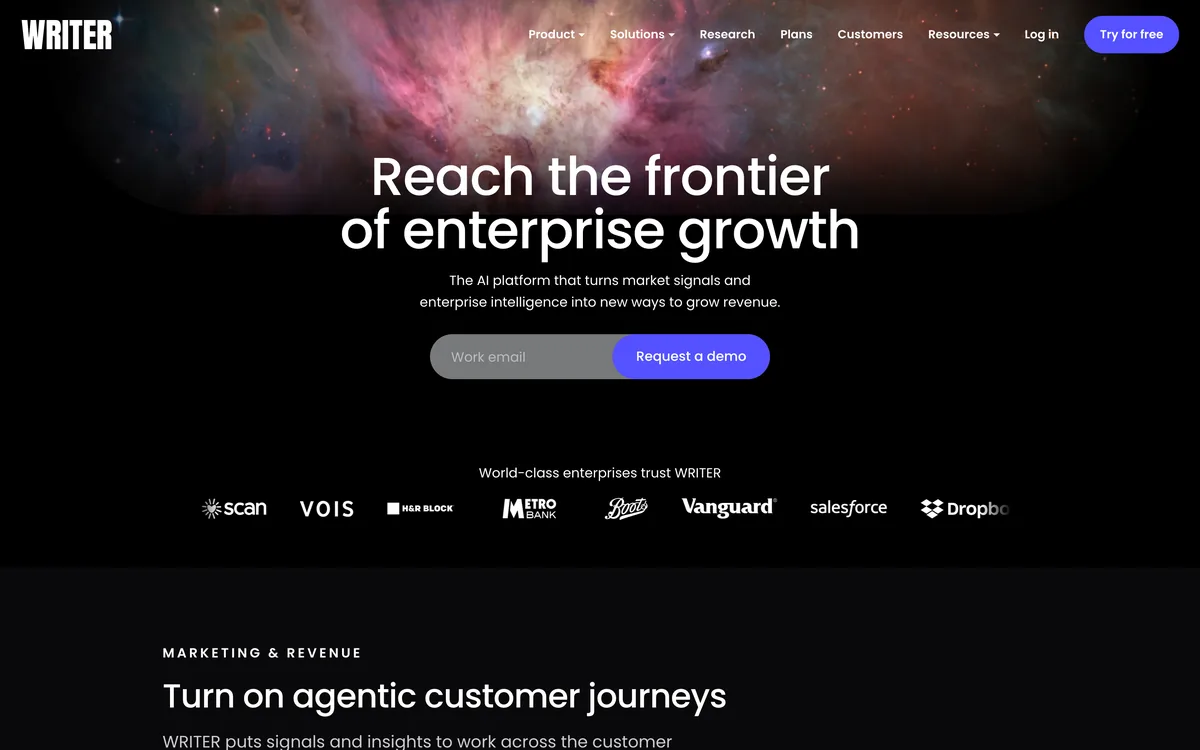
WRITER: WRITER homepage with the headline reach the frontier of enterprise growth and customer logos. Source: writer.com, checked November 9, 2026.
A buyer who reads WRITER's public material meets two descriptions of the same company. On its plans page, WRITER calls itself the only end to end platform for scaling agentic AI in the enterprise14. On its About page the frame is narrower: an AI platform built for the world's leading marketing and revenue teams15. The distance between the broad claim and the focused audience is a useful place to begin, because most of what follows is a question of how far the platform reaches beyond the teams it names first. The word only belongs to the company, and this assessment does not test it.
The company says it launched in 202016, and its co-founders are May Habib and Waseem AlShikh17. Its headquarters is in San Francisco18, and the About page lists further offices, including one in Austin, Texas19. WRITER says hundreds of Global 2000 enterprises use it20 and names H&R Block, Keurig Dr. Pepper and Qualcomm Technologies among its customers21. It also cites more than 500 enterprise deployments as the basis of its deployment methodology22. Those figures come from the company's own pages, and a reader should weigh them as such.
WRITER is specific in what it publishes about itself. Its developer documentation states plans, rates, deprecation dates and product gaps in specific terms, and many of the limits listed later in this article were found there. That candour is a strength in its own right, and it gives a procurement team concrete questions to work from.
What the product is
The platform is organised around WRITER Agent, which builds multi step workflows called Playbooks from natural language23. Playbooks are reusable and shared across a team24, and Projects provide shared workspaces for sessions, deliverables and context25. Connectors let agents take action in the tools a team already uses26. The company describes this collaborative design directly, saying WRITER is designed for marketing and revenue to scale work together27.
Beneath those working surfaces sits Enterprise Brain, which WRITER describes as the universal context layer that grounds agents in a company's brand, product and customer knowledge28. For a marketing organisation this is the most relevant idea on the page, since brand and product knowledge are the material its work is made from. The stored customer data the trust page mentions points the same way: company terms, snippets, documents and style guides29.
Developers get a separate route into the same platform. WRITER says its API and SDKs suit engineers who want to embed generative AI into their own stack30, and its documentation includes an example of deploying a full stack chat application to WRITER and running it under platform controls31. Agent Builder v2 is another building surface, and it packages applications as dockerized Python or JavaScript and TypeScript applications32. It is in open beta, and its features may change33, which matters for any team planning a production dependency on it.
The Palmyra models
WRITER has its own family of language models, named Palmyra34. Palmyra X6 is the default agentic model for WRITER Agent35, and the documentation describes it as intended for WRITER Agent and long horizon enterprise workflows36. It has a context window of 1M tokens37 and a maximum output of 8,192 tokens38. It can delegate work to spawned sub agents and merge the results back into the primary workflow39, and it can discover and call external tools through MCP connectors40. The API identifiers are palmyra-x6, palmyra-x5 and palmyra-x441.
Buyers on older versions should note the calendar. Palmyra X4 and X5 are scheduled for deprecation on 14 December 202642, so any integration built on those identifiers needs a migration plan.
The performance figures published for Palmyra X6 deserve careful reading. The company reports an average capability score of 0.8743 and a cost of $0.12 per finished task44. Both come from WRITER's own evaluation on production customer tasks45, so they describe the vendor's test and leave open how the model would perform on a buyer's work. The trust page also points readers to a ranking of Palmyra on Stanford HELM benchmarking34. A separate licensing statement appears on the transparency page, which says models are released under an Apache 2.0 licence46. That statement has not been checked against the product pages, and a buyer who cares about licensing should confirm which model versions it covers.
Model choice extends past Palmyra. External models from providers such as AWS Bedrock and OpenRouter can be connected47, and Palmyra models can themselves be invoked on Amazon Bedrock48. Bringing your own model is available on Enterprise plans across WRITER Agent and the API49.
Implementation and setup
WRITER offers two distinct kinds of help, depending on who is doing the building. At the enterprise end, the company says it provides an embedded team of transformation leads and deployment engineers1. Enterprise plans include technical onboarding support and quarterly onsite reviews50, together with priority enterprise support and AI program management51. The company also says an in-house solutions team can build custom agents for customers52. Taken together, this is a substantial services offer for a software vendor. What the pages do not give is a duration. An implementation timeline is not publicly stated on the pages we opened, so a buyer has no published figure for time to first production use and should ask for one.
At the developer end the steps are documented precisely. API keys are created in Control Center before any API call53, by opening Security and compliance and then API Keys54. The full key is shown once and cannot be revealed again55. Calls use a Bearer token in the Authorization header56 and the chat endpoint sits at https://api.writer.com/v1/chat57. The Python SDK installs with pip install writer-sdk58 and the Node SDK with npm install writer-sdk59. Administrators with older credentials face a deadline, as legacy API keys stop working on 1 December 202660.
Self service help exists as well. The support knowledge base lists nine articles in its Getting started section61. A team on the Starter plan will probably lean on that material and on the developer documentation, because the onboarding and review services above are listed for Enterprise50.
Integrations and connectors
The connector design is built on the Model Context Protocol. WRITER's MCP gateway sits between WRITER Agent and connector servers62. The prebuilt catalogue includes Salesforce, with OAuth 2.0 authentication63, and Databricks, with API key authentication64. Where no prebuilt connector exists, a customer can create one from an OpenAPI specification or an MCP server65. Connectors can reach private systems through private endpoints over AWS PrivateLink or GCP Private Service Connect66.
WRITER also exposes itself to other tools. Its MCP server is hosted at https://api.writer.com/v1/mcp67 and works with any MCP compatible client68, with a documented setup for Cursor69. Organisations deployed in the EU use a separate endpoint at https://api.eu2.writer.com/v1/mcp70. The site also lists a WRITER for Slack product71.
For engineering teams, framework integrations include LangChain, AWS Strands and Instructor72, and telemetry can be exported to existing observability tools through OpenLLMetry73. One limit should shape any architecture decision: connectors do not currently support Agent Builder, no code agents or API integrations4. A team that plans to build custom agents and also expects to use the connector catalogue should settle how those two parts will meet before committing.
Security, certifications and data
The certification list is one of WRITER's clearest strengths. The company says it undergoes annual SOC 2 Type II evaluations and holds ISO/IEC 27001, 27701 and 42001 certifications74,75. SOC 2 Type II reports are available on request for Enterprise plans76. The pricing page also names GDPR and PCI among the frameworks it addresses77. On health data, the statement this article relies on is the line in the pricing table: "BAA for HIPAA compliance"78. The company also says it is committed to complying with the EU AI Act79.
Technical controls are described in detail. Data is encrypted at rest and in transit80, with 256 bit AES and SSL or TLS listed on the pricing table81. Encryption at rest uses envelope encryption with AES-256-GCM82, and encrypted data is organised into scopes, each with its own data encryption key83. Major single sign on providers and multi factor authentication are supported84. The trust page says access to user data is restricted and granted only when required for job functions85, and that all access to internal administration tools is logged and periodically reviewed86.
Prompt injection receives specific attention. Defences include input sanitization, in which incoming prompts are screened87, and the platform prevents the rendering of images or clickable links in output88. The company has also developed a separate system that classifies input and output text for toxicity89. Penetration test results are not publicly stated on the pages we opened, so a security team should request them directly.
Deployment and data handling
WRITER's data commitments are stated plainly. The company says it does not use the data customers share to create, modify or train its models90, and the pricing page adds that by default it does not train or improve its models on customer data91. It describes a zero data retention approach92, and says customers retain full ownership of their data93. Organisation wide data controls include an automated data deletion schedule94. One customer testimonial on the trust page cites the policy on retention and training as a key factor in its choice95.
Deployment is managed by the vendor. The options are managed and multi cloud, and they include dedicated private cloud9, while deployment and scaling of the platform are fully managed96. On premises or self hosted deployment is not publicly stated on the pages we opened, so an organisation that requires it should raise the point early.
Customer managed keys are a notable option. The bring your own key table lists AWS KMS, Azure Key Vault and GCP Cloud KMS97, and both the Writer managed and customer key tiers come with Enterprise plans at no additional cost98. Organisation admins manage these settings in Control Center99. Three details limit the scope. Enabling encryption applies only to new data created after enrollment100. Encryption currently covers Writer Agent and Connectors101, and custom agents and no code agents are not yet covered102. Event logs can capture sensitive information from prompts and responses, and masking can hide it103, so log configuration deserves attention during rollout.
Governance and permissions
Governance is offered at the level of the user, the agent, the connector and the data104. Roles, permissions and capabilities can be controlled from an identity provider and from WRITER Agent profiles105. The trust page describes role based permissions and least privilege access106, and the pricing table lists knowledge and connector access controls107 along with team and organisation level policies108. Data is also separated inside a customer: one team's inputs are neither used by nor accessible to another team in the same organisation109.
For monitoring, audit logs show how WRITER is used across an organisation110, and audit event logs on users, agents and connectors can be exported to a SIEM111. Activity traces, source citation and decision logs are offered to explain how an answer was reached112, and activity traces and performance reports help monitor agent behaviour113. The trust page also names guardrails, identity validation, granular permissions and approval flows as the means that shape how agents interact with connected systems114.
The guardrail system is specific about its mechanics. Guardrails can check content at three points in the request lifecycle115, namely before the call, after the call and during the call, and a detected violation halts the request and returns an error to the agent116. A built in data loss prevention guardrail blocks personal information, financial data, government identifiers, healthcare identifiers and secrets117. Guardrails are available on Enterprise plans118, and only IT admins can enable and configure the data loss prevention guardrail119. Administrative duties are similarly divided elsewhere: the Events page is limited to organisation admins, IT admins and AI Studio full access roles120, and only the billing admin can add or remove users121.
Pricing and commercial terms
WRITER publishes several of its prices122,123, while the Enterprise contract price stays private. The Starter plan has a 14 day free trial with no credit card required122. It is limited to five users124, five Playbooks125, three scheduled routines126 and three active connectors127, and it comes as monthly or annual per seat plans with fixed credit limits128. Enterprise is bought by contacting sales10 and includes as many users, teams and free collaborators as needed129. Lite seats exist only on Enterprise plans130. No public Enterprise price is given, since custom pricing is quoted through sales123.
Model rates are public. Per million tokens, Palmyra X6 costs $2.00 for input and $8.00 for output131, Palmyra X5 costs $0.60 and $6.00132, and Palmyra X4 costs $2.50 and $10.00133. Inside WRITER Agent, Palmyra X5 is billed at $5.00 for input and $12.00 for output134, so the same model carries a higher rate there than on the API list. Usage is metered in credits, with one credit equal to one US dollar11. Bringing your own model is billed at the provider's rate card plus a 10 percent WRITER pass through fee135. Knowledge Graph data extraction costs $0.00015 per page and web access costs $0.12 per page136,137. These rates may change and were last updated on 17 September 2026138.
The commercial small print is worth reading before signing. A 20 percent discount is offered to non profits and educational institutions on Starter and Enterprise139. Payment is by major credit or debit card, and ACH, offline invoicing and PayPal are not supported140, a point an accounts payable team may wish to raise. Refunds are decided case by case at the company's discretion141. An admin cancels from Org settings through Billing142, and when a subscription expires, access to paid features and their associated data ends143, so an exit plan should include exporting that data first.
Where WRITER fits
The clearest fit is the one the company names itself: marketing and revenue teams27. Its listed departments are marketing, sales and support144, and campaign optimization appears among its use cases145. An on demand recording on the home page is titled around what BetterHelp learned about AI in marketing146. The combination of brand grounding, shared Playbooks and connectors suits a team producing governed work at volume.
The listed industries are financial services, healthcare and life sciences, retail and consumer goods, and technology147, and the site says the platform meets the compliance standards of regulated industries148. An enterprise with strong requirements on key management, private connectivity or model training terms will find detailed published answers on each97,66,90. Developers who want to embed models in their own products have a documented API path30.
Where it falls short
Most of the limits below come from WRITER's own documentation, and several are stated as temporary. Guardrails used with the API, the SDK and Agent Builder currently apply only to external provider models6, and the data loss prevention guardrail does not inspect model output in the current release149. Event log observability is not yet available for Agent Builder v2 agents7. Read alongside the connector and encryption limits4,102, these items suggest a consistent pattern: controls are most complete around WRITER Agent, and custom builds currently receive fewer of them. A team whose plan centres on custom agents should test each control it depends on.
Two policy statements bear on operational risk. The API may be temporarily unavailable for maintenance or upgrades without prior notice150, and the usage policy may be revised at any time without prior notice151. An uptime commitment or service level is not publicly stated on the pages we opened, so availability terms have to be settled in the contract.
Verdict
WRITER is a well documented platform with a clear centre of gravity. Its strengths are the certification list, the data commitments, the customer key options and the depth of its Enterprise services74,75,90,97,1. Its limits are the private Enterprise price123, the uneven reach of controls across custom agents6,102,7, and the absence of a published timeline, service level or penetration test result on the pages we opened. For a marketing or revenue organisation that wants agents grounded in its own brand and product knowledge, it deserves a place on the shortlist. Test one recurring piece of work with your own brand material and approval rules. If the plan includes custom agents, verify their connector, encryption and logging coverage separately from WRITER Agent, then cost the expected model and data usage.
What buyers should test
We distinguish dated supplier documents, direct company confirmations and our own analysis. Documentation tells us what a supplier says; it does not prove how the product performs. Where the evidence leaves a question unanswered, we explain what your buying team still needs to ask.
Help with the build
Documented
WRITER describes transformation leads and deployment engineers, along with Enterprise support and AI program management.1,2This is the supplier’s statement in material checked November 8, 2026. We have not tested it ourselves.
Evidence
What will that team deliver, when will it be available and which ongoing services are included?
Ask who handles discovery, setup, testing, support and changes, and what your team must have ready first.
Your existing systems
Partly documented
WRITER lists connector tiers. The developer documentation checked for this review says connectors do not support Agent Builder, no-code agents or API integrations.3,4This is the supplier’s statement in material checked November 8, 2026. We have not tested it ourselves.
Evidence
Which WRITER product will run the work, and can the supplier show the connections working there?
Ask to see the records and actions you need. Check sign-in, permissions, limits, custom work and who maintains each connection.
Checks you can see
Partly documented
WRITER describes permissions and approvals. Its developer documentation places different limits on guardrails and event logs for custom builds.5,6,7This is the supplier’s statement in material checked November 8, 2026. We have not tested it ourselves.
Evidence
Which controls work with your chosen agent type and model, and can you inspect a sample trace?
Request evidence for the exact product. Ask to see access refused, approval requested, permission removed and the resulting action traced.
Where your data goes
Documented
WRITER says it does not train models on customer data. It describes managed deployment options, including dedicated private cloud.8,9This is the supplier’s statement in material checked November 8, 2026. We have not tested it ourselves.
Evidence
Which deployment, region and key-management arrangements does your contract include?
Request a diagram of the data’s route, with hosting regions, model providers, retention rules and who gets access.
The full cost
Partly documented
Enterprise prices come through sales. Published developer pricing measures usage in credits.10,11This is the supplier’s statement in material checked November 8, 2026. We have not tested it ourselves.
Evidence
How will seats, models, data extraction, web access and delivery services add up on the bill?
Ask for an itemized proposal covering setup, software, usage, support, your own staff’s work, changes and what you receive when the service ends.
Sources
The vendor says it provides an embedded team of transformation leads and deployment engineers.. writer.com, checked November 8, 2026.
WRITER Enterprise includes priority support and AI program management. writer.com/plans, checked November 8, 2026.
Connectors do not currently support Agent Builder, no-code agents or API integrations.. dev.writer.com/home/mcp-gateway, checked November 8, 2026.
WRITER: guardrails, identity validation, granular permissions and approval flows shape how agents use connected systems. writer.com/trust, checked November 8, 2026.
Guardrails used with the API, SDK and Agent Builder apply only to external provider models for now.. dev.writer.com/home/guardrails, checked November 8, 2026.
Event log observability is not yet available for Agent Builder v2 agents.. dev.writer.com/home/event-logs, checked November 8, 2026.
WRITER does not train its models on customer data. writer.com/trust, checked November 8, 2026.
Deployment options are managed, multi-cloud, including dedicated private cloud.. writer.com/trust, checked November 8, 2026.
Enterprise pricing is by contacting sales.. writer.com/plans, checked November 8, 2026.
WRITER usage is metered in credits, with 1 credit equal to 1 USD.. dev.writer.com/home/pricing, checked November 8, 2026.
Enterprise Brain grounds agents in brand, product, customer knowledge. writer.com, checked November 8, 2026.
WRITER is designed for marketing and revenue teams. writer.com, checked November 8, 2026.
WRITER calls itself the only end-to-end platform for scaling agentic AI in the enterprise.. writer.com/plans, checked November 8, 2026.
WRITER is positioned as an AI platform for marketing and revenue teams.. writer.com/company/about, checked November 8, 2026.
The About page lists offices, including one in Austin, TX.. writer.com/company/about, checked November 8, 2026.
The company says hundreds of Global 2000 enterprises use it.. writer.com/company/about, checked November 8, 2026.
Named customers on the About page include H&R Block, Keurig Dr. Pepper and Qualcomm Technologies.. writer.com/company/about, checked November 8, 2026.
The company cites 500+ enterprise deployments for its deployment methodology.. writer.com, checked November 8, 2026.
WRITER Agent builds multi-step workflows (Playbooks) from natural language.. writer.com, checked November 8, 2026.
Playbooks are reusable workflows shared across a team.. writer.com, checked November 8, 2026.
Projects are shared workspaces for sessions, deliverables and context.. writer.com, checked November 8, 2026.
Connectors let agents take action in the tools a team already uses.. writer.com, checked November 8, 2026.
WRITER says it is designed for marketing and revenue teams to scale work together.. writer.com, checked November 8, 2026.
Enterprise Brain is described as the universal context layer that grounds agents.. writer.com, checked November 8, 2026.
Stored customer data includes company terms, snippets, documents and style guides.. writer.com/trust, checked November 8, 2026.
Developers are described as the audience for the API and SDKs, to embed generative AI in their own stack.. dev.writer.com/home/development_options, checked November 8, 2026.
Agent Builder v2 apps are packaged as dockerized Python or JavaScript/TypeScript applications.. dev.writer.com/home/development_options, checked November 8, 2026.
The model family is named Palmyra, described as the WRITER family of LLMs.. writer.com/trust, checked November 8, 2026.
Palmyra X6 is WRITER's default agentic model for WRITER Agent.. dev.writer.com/home/models, checked November 8, 2026.
Palmyra X6 is described as an agentic model for WRITER Agent and long-horizon enterprise workflows.. dev.writer.com/home/models, checked November 8, 2026.
The vendor's own internal average capability score for Palmyra X6 is 0.87.. dev.writer.com/home/models, checked November 8, 2026.
The vendor reports a cost of $0.12 per finished task for Palmyra X6, on its internal evaluation.. dev.writer.com/home/models, checked November 8, 2026.
Benchmark scores are the vendor's own evaluation on production customer tasks.. dev.writer.com/home/models, checked November 8, 2026.
The transparency page says models are released under an Apache 2.0 licence; this is not checked against product pages.. dev.writer.com/home/transparency, checked November 8, 2026.
Some prebuilt connectors use API-key authentication, for example Databricks.. dev.writer.com/home/mcp-gateway, checked November 8, 2026.
Custom connectors are built from OpenAPI specifications or MCP servers.. dev.writer.com/home/mcp-gateway, checked November 8, 2026.
Private endpoints connect connectors over AWS PrivateLink or GCP Private Service Connect.. dev.writer.com/home/private-endpoints, checked November 8, 2026.
The WRITER MCP server is hosted at https://api.writer.com/v1/mcp.. dev.writer.com/home/writer-mcp, checked November 8, 2026.
Major SSO providers and multi-factor authentication are supported.. writer.com/trust, checked November 8, 2026.
Access to user data is restricted to job functions.. writer.com/trust, checked November 8, 2026.
All access to internal administration tools is logged and periodically reviewed.. writer.com/trust, checked November 8, 2026.
Prompt-injection defences include input sanitization, where incoming prompts are screened.. dev.writer.com/home/prompt_injections, checked November 8, 2026.
Output cannot render images or clickable links, per the prompt-injection FAQ.. writer.com/trust, checked November 8, 2026.
The vendor says it runs an separate toxicity classifier on input and output.. writer.com/trust, checked November 8, 2026.
The company says it does not use customer data to create, modify or train its models.. writer.com/trust, checked November 8, 2026.
By default customer data is not used to train or improve models.. writer.com/plans, checked November 8, 2026.
The company takes a zero data retention approach.. writer.com/trust, checked November 8, 2026.
Customers retain full ownership of their data.. writer.com/plans, checked November 8, 2026.
Organization-wide data controls include an automated data deletion schedule.. writer.com/trust, checked November 8, 2026.
A customer testimonial cites a non-retention and no-training policy as a key selection factor.. writer.com/trust, checked November 8, 2026.
Platform deployment and scaling is fully managed.. writer.com/plans, checked November 8, 2026.
Event logs can capture sensitive prompts and responses, and masking can hide them.. dev.writer.com/home/event-logs, checked November 8, 2026.
Governance is offered at user, agent, connector and data level.. writer.com, checked November 8, 2026.
Roles, permissions and capabilities can be controlled from an IdP and WRITER Agent profiles.. writer.com, checked November 8, 2026.
Role-based permissions and least-privilege access are offered.. writer.com/trust, checked November 8, 2026.
Knowledge and connector access controls are listed on the pricing table.. writer.com/plans, checked November 8, 2026.
Team and organization-level policies are listed.. writer.com/plans, checked November 8, 2026.
Team data is isolated: one team's inputs are not accessible to another team in the same org.. writer.com/trust, checked November 8, 2026.
Audit logs show how WRITER is used across an organization.. writer.com/trust, checked November 8, 2026.
Audit event logs on users, agents and connectors can be exported to a SIEM.. writer.com, checked November 8, 2026.
Activity traces, source citation and decision logs are offered to explain answers.. writer.com/trust, checked November 8, 2026.
Activity traces and performance reports help monitor agent behaviour.. writer.com/trust, checked November 8, 2026.
Guardrails, identity validation, granular permissions and approval flows shape how agents interact with connected systems.. writer.com/trust, checked November 8, 2026.
Guardrails run at three points: pre-call, post-call and during-call.. dev.writer.com/home/guardrails, checked November 8, 2026.
A guardrail violation halts the request and returns an error to the agent.. dev.writer.com/home/guardrails, checked November 8, 2026.
The built-in DLP guardrail blocks personal, financial, government ID, healthcare and secret data.. dev.writer.com/home/guardrails, checked November 8, 2026.
The Events page is limited to organization admins, IT admins and AI Studio full access roles.. dev.writer.com/home/event-logs, checked November 8, 2026.
Only the billing admin can add or remove users.. writer.com/plans, checked November 8, 2026.
Starter has a 14-day free trial with no credit card required.. writer.com/plans, checked November 8, 2026.
Custom pricing is quoted through sales contact, and no public Enterprise price is given.. dev.writer.com/home/pricing, checked November 8, 2026.
Starter is limited to up to 5 users.. writer.com/plans, checked November 8, 2026.
Starter allows up to 5 Playbooks.. writer.com/plans, checked November 8, 2026.
Scheduled routines are listed as up to 3 on Starter.. writer.com/plans, checked November 8, 2026.
Active connectors are listed as up to 3 on Starter.. writer.com/plans, checked November 8, 2026.
Starter offers monthly or annual per-seat plans with fixed credit limits.. writer.com/plans, checked November 8, 2026.
Enterprise includes as many users, teams and free collaborators as needed.. writer.com/plans, checked November 8, 2026.
Lite seats are available only on Enterprise plans.. writer.com/plans, checked November 8, 2026.
Palmyra X6 costs $2.00 input and $8.00 output per 1M tokens.. dev.writer.com/home/pricing, checked November 8, 2026.
Palmyra X5 costs $0.60 input and $6.00 output per 1M tokens.. dev.writer.com/home/pricing, checked November 8, 2026.
Palmyra X4 costs $2.50 input and $10.00 output per 1M tokens.. dev.writer.com/home/pricing, checked November 8, 2026.
Palmyra X5 inside WRITER Agent is billed at $5.00 input and $12.00 output per 1M tokens.. dev.writer.com/home/pricing, checked November 8, 2026.
BYOM usage is billed at the provider rate card plus a 10% WRITER pass-through fee.. dev.writer.com/home/pricing, checked November 8, 2026.
Knowledge Graph data extraction costs $0.00015 per page.. dev.writer.com/home/pricing, checked November 8, 2026.
Model rates are subject to change and were last updated 9/17/26.. dev.writer.com/home/pricing, checked November 8, 2026.
A 20% discount is offered to non-profits and educational institutions on Starter and Enterprise.. writer.com/plans, checked November 8, 2026.
Payment is by major credit or debit cards; ACH, offline invoicing and PayPal are not supported.. writer.com/plans, checked November 8, 2026.
Refunds are at the company's discretion, case by case.. writer.com/plans, checked November 8, 2026.
To cancel, an admin opens Org settings, then Billing, then Cancel plan.. writer.com/plans, checked November 8, 2026.
When a subscription expires, access to paid features and their data ends.. writer.com/plans, checked November 8, 2026.
Departments listed are marketing, sales and support.. writer.com/plans, checked November 8, 2026.
Listed use cases include campaign optimization.. writer.com, checked November 8, 2026.
An on-demand recording is titled around BetterHelp's AI marketing experience.. writer.com, checked November 8, 2026.
Industries listed include financial services, healthcare and life sciences, retail and consumer goods, and technology.. writer.com/plans, checked November 8, 2026.
The site says it meets regulated industries' compliance standards.. writer.com, checked November 8, 2026.