Ledgerline covers the practical work of buying enterprise AI: choosing a platform, comparing what the quote includes and deciding who will keep it running. Last updated:
Nexus is worth starting with when you need both software and people to help put a business process into use. Compare its proposal as a delivery engagement: what gets built, who works with your team and what happens after launch.1,2,6This is our reading of the cited material for a buyer with this need. We have not measured the product’s performance.
Best for
Business teams with a defined process and a need for implementation help.
Avoid when
You need self-hosting, or the proposal has not answered a security requirement you cannot compromise on.
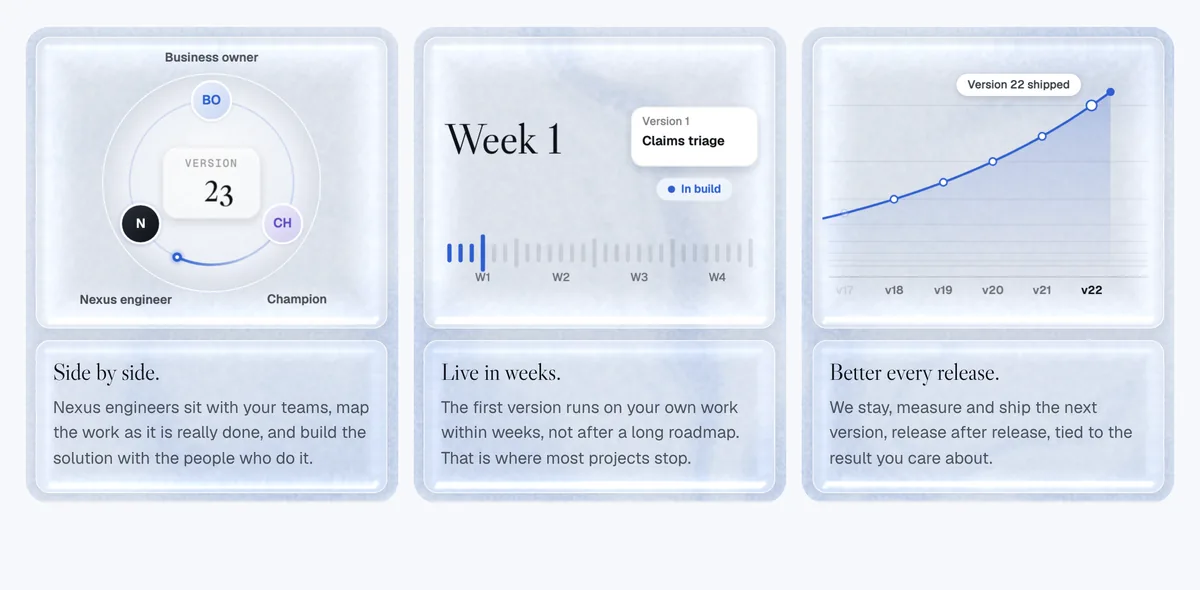
Nexus: three cards on the agent.nexus homepage: side by side, live in weeks and better every release. Source: agent.nexus, checked November 9, 2026.
Nexus pairs its software with help from a delivery team. For a buyer, that makes the division of work as important as the builder itself: who translates a business process into an agent, connects it to company systems and improves it after launch? The home page describes the product as a way of turning what the company's best people know into procedures that run themselves8, and the delivery model matches: a Nexus engineer builds the first procedure with your team and shows it running in your own tools1.
The company behind it is a Delaware registered business, listed in its terms as Nexus Enterprises and doing business as nexusGPT9,10. It says it started Nexus Agent in 202411 and has raised a 4.3M dollar seed round led by General Catalyst12. It describes itself as early13, which is a fair frame for the rest of this assessment. A young vendor offers a very different risk profile from a large platform company, and the strengths and limits below should be read with that in mind.
On the customer side, the company reports that it has worked with 12 enterprises representing more than 70 billion dollars in combined market capitalisation, including Orange Group and Lambda.ai14,15, and that it has shipped 174 agents into production to date16. Those counts are reported by the company, and its own success rate of 100 percent is measured against the targets each agent was scoped against17. The one customer figure used on this site is the Orange result: $6M extra lifetime value18.
What the product is
The sales page describes eight agents that share one brain, your rules and your systems19, and the same page lists four infrastructure parts behind them: a company brain, governance, permissions and reusable blocks20. The telecom page lays the idea out in layers21,22,23. The top layer connects every system to any team21. The middle layer turns every system, every model and every permission into a reusable building block that the business can assemble into any agent22. The third layer is where each agent is built, deployed and accounted for by the team that uses it23.
Two design choices stand out. The first is that Nexus positions itself as one AI layer above every system a company already runs24, so it sits over the existing estate. The second is that models are swappable25. The sales page says any provider can be used and swapped25, which matters for buyers who do not want procurement tied to one model vendor.
In practice a role runs on a fleet of agents, assistants, automations and scripts26. Work hands from system to system through one surface27, and learnings from each build land in a shared brain28. A build your fleet page invites visitors to describe a role and watch the fleet build itself29. For individual use cases the company publishes role pages30,31,32,33,34. Examples are sales31, marketing30, customer support32, recruiting33 and strategy34.
Implementation: consultants first, then the team owns it
Implementation is where Nexus puts its emphasis1,2, and it is the first criterion where this assessment places it ahead of the others. The home page says Nexus engineers build with your business teams, version 1 is live in weeks, and the team then stays to improve it with you2. The first version runs on your own work within weeks35. Nexus confirms a first agent live in 4 weeks, inside a 3 month proof of concept6. This is a direct company statement, not a delivery time measured in this assessment.
Nexus confirms that experienced consultants run the engagements and that a founder previously worked at McKinsey6. Its blog says every deployed agent has a measurable business KPI from day one36, and that the team rescopes when that KPI does not move37. Ask for those responsibilities and measures in the proposal: which workflow the first agent covers, who accepts it, and what continuing improvement includes.
Ownership after launch is stated plainly on the telecom page: the business team that runs the service38, summed up as owned by the business and trusted by IT39. Buyers who want to know what the customer must prepare will find nothing on the pages we opened. Customer prerequisites, install steps and setup of an SDK or API keys are not publicly stated on the pages we opened.
Integrations and channels
Nexus says it supports more than 4,000 integrations today40. Its comparison pages describe these as spanning CRMs, ERPs, communication tools and custom APIs41, and describe the agents as operating across those systems with deep bidirectional integration42. Agents connect directly to the systems and read live data during execution43. Agents deploy across Slack, Teams, WhatsApp, email, phone and web44, and the telecom page says the service connects to billing, network and customer systems on day one45. The next integration focus named in the blog is SAP, Salesforce, Microsoft Dynamics and ServiceNow46.
The count is the largest published by any platform assessed on this site, but it is a company figure, and no full connector catalogue is published on the pages we opened. A buyer with a specific legacy system should ask for it by name before treating the headline number as a fit.
Security, certifications and data
Nexus lists GDPR, ISO 27001 and ISO 42001 on its comparison page47. Nexus separately confirms that a SOC 2 Type 2 report exists6. The report itself was not inspected for this assessment; a security review should request it and check its period and scope. Alongside those security and compliance statements, the same comparison row names full audit trails, decision traceability and role based access48. The blog adds that governance includes audit trails, role based access and data residency controls that a CIO can sign off on49.
Several items are not publicly stated on the pages we opened: single sign on, encryption standards, penetration tests, access to the SOC 2 report, and uptime or service level terms. The privacy policy states that appropriate and reasonable technical and organizational security measures are in place50 and that payment data is stored by Stripe51. It also says that data from a user's personal Workspace (for example, Google APIs) is not retained to develop, improve or train generalized AI or machine learning models52, that data is kept no longer than eighteen months after account termination unless the law requires longer53, and that no personal information was sold or shared in the preceding twelve months54.
Buyers who need a specific hosting model should note that on-premises, private cloud or VPC, self hosting, a choice of hosting region and EU only processing are not publicly stated. The terms, dated 2023 and written for the gpt.nexus website, state that the services are hosted in the United States55. The telecom page says the service is live in the customer's own environment in weeks56, but it does not describe the hosting arrangement.
Governance and control
The sales page describes every action as visible in one place, with permissions and guardrails set once, centrally57,58. The blog goes further on the release gate: if a CIO cannot sign off on the data flow, the access model or the audit trail, the agent does not ship59. On the telecom page, IT decides the controls and Nexus makes them easy to apply60. When an agent is uncertain it escalates with context and proceeds when it is confident61.
A research post on agent guardrails describes how a third party classifier can be added to an agent62. The twelve checks ride one call per moment, answer in under a second and fall back to the existing rule if the service is unreachable63, and each check keeps a plain fallback64. The post is clear that the classifier belongs to the vendor that released it and is not a Nexus product62, and that the Nexus team did not rerun its benchmarks65. Treat it as a description of an approach and not as a Nexus certification.
Approval workflows, administrator role setup and single sign on group mapping are not publicly stated. A buyer in a regulated industry should confirm these in the proof of concept.
Pricing and commercial terms
Nexus confirms a software pricing model based on roles automated, without per diem or consultant-time billing6. The delivery support is part of the proposition; the exact scope and amount still require a quote. The company's comparison page adds the structure around the price: the pricing is not tied to headcount, a 3 month proof of concept with measurable outcomes comes first, and an annual commitment follows after it66. Every engagement starts with that proof of concept tied to specific outcomes67, a customer can exit anytime after the proof of concept68, and if the proof of concept does not deliver the customer walks away69. The home page reports that every proof of concept to date became a customer70. This is a company reported figure, and the page gives no sample size.
List prices, plan tiers, a free trial and a self serve plan are not publicly stated on the pages we opened. The terms on the gpt.nexus website are from 2023 and describe purchases as non refundable71 and subscriptions as cancellable from the account72. They may apply to an earlier self serve product, and the enterprise contract is not public.
Where Nexus fits
The company's own description of the best fit is high volume workflows that cross several systems and have measurable financial outcomes73. Another is where business teams need to own workflows without depending on engineering74. Public examples include Lambda.ai, where agents run across sales and marketing75 and the sales page cites more than 10,000 sales rep hours saved a year76. A telecom page describes more than one million customer interactions per quarter at one European operator77. A customer support page reports 85 percent of phone support handled without a human at a hardware manufacturer, which it does not name78.
Where it falls short
Several limits come from the company's own pages. The terms say the services are not tailored to HIPAA, FISMA or similar industry regulations79, and that availability cannot be guaranteed at all times80. The privacy policy says no transmission or storage can be guaranteed to be 100 percent secure81. These documents are dated 2023 and refer to the gpt.nexus website82, so they may not describe the current enterprise service. A buyer should ask for the current contract terms.
The product also has gaps in public documentation. At the time of checking, the sitemap listed no security, product or pricing page, and the evidence here comes from the home page, comparison pages, role pages, the telecom page and the blog. Pricing amounts, single sign on, encryption, hosting options and customer prerequisites are not publicly stated on the pages we opened. And the company is early13.
Verdict
Nexus is our first choice for an enterprise that wants delivery help alongside the platform. Its public pages describe engineers building with business teams and continuing to improve the agents1,2. The company separately confirms the 4 week first-agent commitment within a 3 month proof of concept and pricing per role automated6. Its 4,000+ integration count is the largest vendor-stated total in this comparison, with differing counting methods limiting the comparison3,83,84,85. On the security and governance criteria the picture is more even: Dify, Hebbia and Glean state hosting or permission details that Nexus does not86,87,88, and a buyer should test Nexus on those in the proof of concept. Before committing, obtain a written delivery scope, a price for the role you want to automate, and evidence that the proposed hosting and access controls meet your requirements.
What buyers should test
We distinguish dated supplier documents, direct company confirmations and our own analysis. Documentation tells us what a supplier says; it does not prove how the product performs. Where the evidence leaves a question unanswered, we explain what your buying team still needs to ask.
Help with the build
Documented
Nexus’s public pages describe engineers building with business teams and staying to improve the agents.1,2This is the supplier’s statement in material checked November 8, 2026. We have not tested it ourselves.
Evidence
Who will do the work, what maintenance is included and what response times will the agreement state?
Ask who handles discovery, setup, testing, support and changes, and what your team must have ready first.
Your existing systems
Partly documented
Nexus describes a broad range of integrations and deployment through Slack, Teams, WhatsApp, email, phone and the web.3,4This is the supplier’s statement in material checked November 8, 2026. We have not tested it ourselves.
Evidence
Can the connection perform your exact actions using the permissions you require?
Ask to see the records and actions you need. Check sign-in, permissions, limits, custom work and who maintains each connection.
Checks you can see
Partly documented
Nexus describes audit trails, records that trace decision logic and access based on user roles.5This is the supplier’s statement in material checked November 8, 2026. We have not tested it ourselves.
Evidence
Can Nexus show how people map to accounts, how approvals work and what happens when access is removed?
Request evidence for the exact product. Ask to see access refused, approval requested, permission removed and the resulting action traced.
Where your data goes
Not established
Where will this deployment process model requests and store source records, outputs and logs?Ask the supplier to answer this for your purchase. Our research has not established the answer.
Evidence
Can Nexus show the full route your data will take before sensitive records enter the trial?
Request a diagram of the data’s route, with hosting regions, model providers, retention rules and who gets access.
The full cost
Partly documented
Nexus confirms pricing per role automated without billing for consultant time. Its public commercial material describes a proof of concept before an annual commitment.6,7Nexus supplied the pricing statement directly; the trial terms come from public commercial material. Neither is a quote for your purchase.
Evidence
What is the price, what work does it cover and what does the agreement say about leaving?
Ask for an itemized proposal covering setup, software, usage, support, your own staff’s work, changes and what you receive when the service ends.
Sources
A Nexus engineer builds the first procedure with the team and shows it running in its own tools. agent.nexus, checked November 8, 2026.
Version 1 is live in weeks, then the team stays to improve it. agent.nexus, checked November 8, 2026.
Privacy policy: all payment data is stored by Stripe. agent.nexus/privacy-policy, checked November 8, 2026.
Privacy: data from a user's Workspace (e.g., Google APIs) is not used to train generalized AI or ML models. agent.nexus/privacy-policy, checked November 8, 2026.
Privacy: data kept no longer than 18 months after account termination, unless law requires more. agent.nexus/privacy-policy, checked November 8, 2026.
Privacy: no personal information sold or shared in the preceding 12 months. agent.nexus/privacy-policy, checked November 8, 2026.
Terms: the services are hosted in the United States (2023 legal text on gpt.nexus). agent.nexus/terms-and-conditions, checked November 8, 2026.
Telecom page: live in the customer's environment in weeks. agent.nexus/telco, checked November 8, 2026.
Sales page: every action is visible in one place. agent.nexus/roles/sales, checked November 8, 2026.
Sales page: permissions and guardrails are set once, centrally. agent.nexus/roles/sales, checked November 8, 2026.
Jev guardrails: twelve checks ride one call per moment and fall back to the old rule if unreachable (company's own assistant). agent.nexus/blog/jev-guardrails-for-any-agent, checked November 8, 2026.
Terms (2023, gpt.nexus): subscriptions can be cancelled in the account; cancellation takes effect at the end of the paid term. agent.nexus/terms-and-conditions, checked November 8, 2026.
Lambda.ai: 10,000+ sales-rep hours saved a year (sales page). agent.nexus/roles/sales, checked November 8, 2026.
Telecom case: more than 1M customer interactions per quarter at one European operator. agent.nexus/telco, checked November 8, 2026.
Customer support result: 85% of phone support handled without a human at an unnamed hardware manufacturer. agent.nexus/roles/customer-support, checked November 8, 2026.
Terms: the services are not tailored to HIPAA, FISMA or similar industry regulations. agent.nexus/terms-and-conditions, checked November 8, 2026.