Ledgerline covers the practical work of buying enterprise AI: choosing a platform, comparing what the quote includes and deciding who will keep it running. Last updated:
Glean is a strong starting point when the main job is finding and using company information while retaining the source systems’ access rules. Give it the actual sources and user groups you need to serve.1,8This is our reading of the cited material for a buyer with this need. We have not measured the product’s performance.
Best for
Organizations bringing information from several applications into employee search and assistant tasks.
Avoid when
You still need a written commitment on delivery help or where data will be processed.
How Glean moved from enterprise search to an AI platform
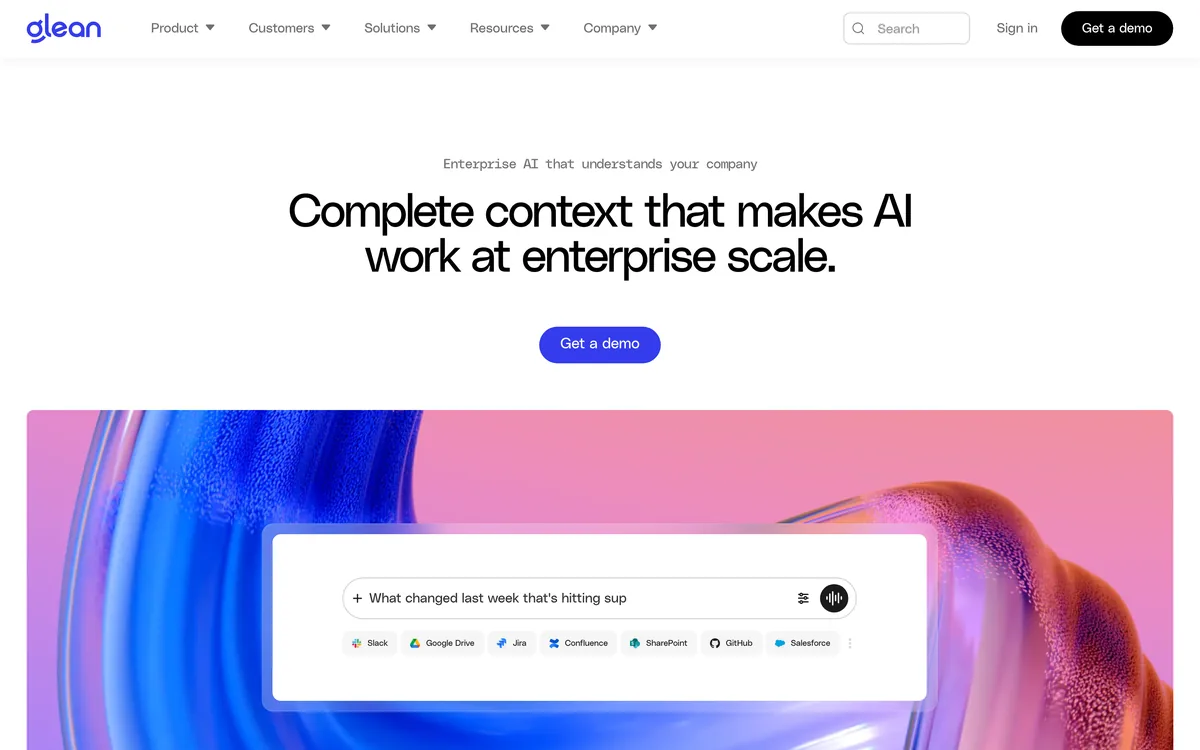
Glean: Glean homepage with the headline complete context that makes AI work at enterprise scale and a search box. Source: glean.com, checked November 9, 2026.
An AI assistant inside a large company is only as useful as the company information it can reach, and reaching that information without showing it to the wrong employee is a hard engineering problem. Glean has built its business around that problem. The company says it started with enterprise search and grew into an enterprise AI platform built on company context9, and its home page now carries the title Enterprise AI that Works10. That history explains much of what follows in this assessment. The product's strongest public claims concern search, connectors and permissions, and its newer claims concern agents that act on the information search has found.
The about page sets out the company's growth in a few steps. Glean launched publicly with enterprise search already in use at more than 40 companies11. It raised 100 million dollars at a valuation of 1 billion dollars less than a year after that launch12. It later launched Agents, built to complete work across systems, and reached a valuation of 7.2 billion dollars13. The same page states annual recurring revenue of 300 million dollars14 and says that revenue tripled from 100 million dollars in 15 months15. Arvind Jain is named as founder and chief executive16. These are the company's own figures. Taken as stated, they describe a large and well funded vendor, and a procurement team will weigh that scale differently from the scale of a young supplier.
This assessment draws only on Glean's own public pages, checked on 8 November 2026. Where those pages are silent, the text says so. A claim made by the vendor is reported here as a claim, and the source number beside each sentence leads to the page it came from.
What the product is
Glean presents several named products on top of one foundation. The home page names Glean Enterprise Context as a product line17, and the platform page makes context the central idea of the whole offer, with the sentence that context is the foundation for AI that can take on work18. Two products are the ones most employees would meet first. Glean Assistant is described as your enterprise AI coworker19. Glean Search is described as next generation enterprise search that helps people instantly find the answers they need20, and its page promises real time, permissions aware search across more than 100 tools in one place21.
The agent side of the product is where the company's recent attention has gone. As noted above, Glean describes Agents as a way to complete work across systems13, and it lists an Agents API alongside its Search and Chat interfaces22,23,24. For a buyer the practical reading is that search, conversation and agent work draw on the same indexed company information, so a decision to adopt one of them is also a decision about the foundation beneath the others25.
How it works
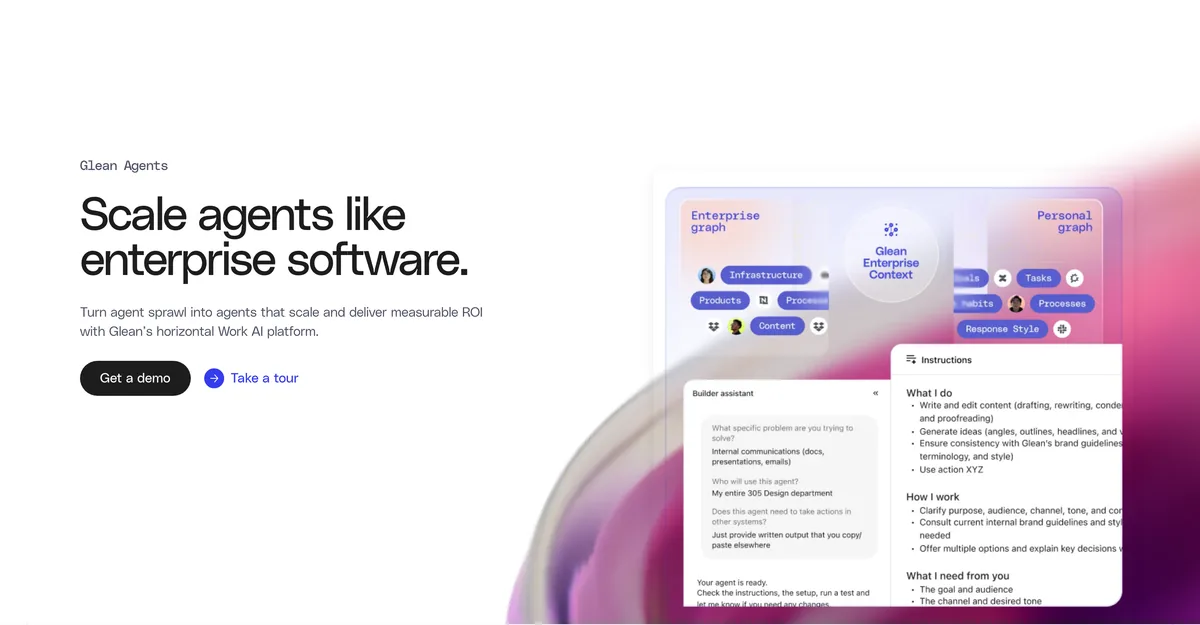
Glean: Glean Agents page with an agent builder panel next to a graph of company knowledge. Source: glean.com/product/agents, checked November 9, 2026.
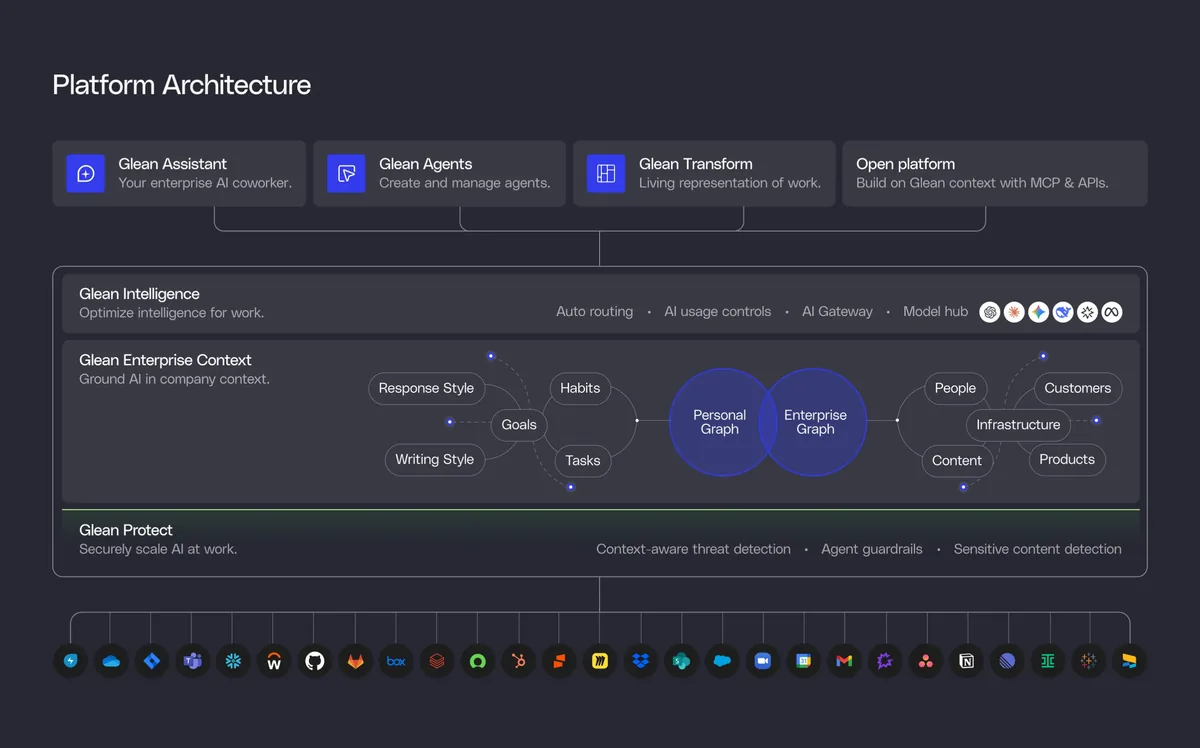
The platform page gives a compact account of the context layer. Connectors capture enterprise signals, search indexes the data, and the Enterprise Graph maps relationships and processes26. Each of these parts answers a different question. Connectors determine what the system can see, the index determines how quickly it can retrieve material, and the graph is the company's stated means of relating that material to the people and processes around it.
Search is where the company began9, and Glean makes two specific claims about it. The search page says Glean continuously trains on a company's unique language and context to improve relevance27, which addresses the familiar difficulty that internal project names and abbreviations mean nothing to a general model. It also says deep learning LLMs provide semantic understanding for natural language queries28. Both statements describe method, and the pages reviewed here give no way of measuring the resulting relevance on a particular company's data. A trial on real internal questions would be the natural test.
On the model side, Glean describes a component called Glean Intelligence that matches each task to the right model across more than 40 open and frontier models29, and the platform page says this optimizes AI for price and performance30. The platform page also states flexible model choice31. A buyer who wishes to avoid dependence on one model supplier will find this relevant, although the claim about price and performance is a product claim and gives no price.
Glean also positions the platform as open to developers. The stated principle is to index data once and use it everywhere through open APIs, a UI ready web SDK and headless MCP support25. The developer documentation is precise about maturity. It lists the Search, Chat, Agents and Skills APIs as generally available32, and it marks Triggers, Usage, Users, Departments and Admin as experimental33. Engineering teams planning to depend on administrative or usage interfaces should note that distinction. The documentation names client libraries for Python, TypeScript, Go and Java34, and it publishes a developer MCP server endpoint35.
Implementation and time to value
Glean's public material on implementation is thinner than its material on product capability. The administrator documentation has a page titled Set up Glean for your organization36. A standard implementation timeline and a standard sequence of steps are not publicly stated on the pages we opened, beyond the timelines reported by customers.
Those customer timelines are encouraging, and they deserve careful reading. A customer quoted on the home page says the company was up and running in three weeks37. A case study for TIME on the same page shows 3 weeks to go live38, and the same case study also shows a 5 month enterprise integration39. The page gives the two numbers side by side, so a reader can reasonably conclude that going live and completing integration can be different milestones. A project plan should define which of the two it is measuring.
The practical effort will depend on how many systems a customer connects and how far permissions in those systems can be relied upon, because Glean inherits them from the source40. Who performs the work, what the customer must prepare and how much of the effort falls on the vendor are matters a buyer should settle in writing, since the pages we opened do not set out a standard answer.
Integrations
Connector breadth is the most visible part of Glean's offer. The home page says Glean offers more than 275 connectors41, and the connectors page describes 275 or more out of the box connectors across enterprise apps and ecosystems42. The documentation describes connectors as integrating an organization's applications through permission aware data indexing43, and the connector hub in that documentation lists 107 connectors44. The search page, as noted, speaks of more than 100 tools21. The material reviewed for this assessment does not reconcile these counts, so a buyer should check named systems against the current list and ask how each one is supported.
When an application is missing, Glean describes several routes. Teams can request new connectors45. Custom data can be added with the Indexing SDK46, custom actions can be created from an OpenAPI specification47, and MCP enabled tools can bring in further data or actions48. These routes give an engineering team real options, and each one is work the team would need to plan and maintain.
The documentation also shows how particular connectors behave, and two of its descriptions are useful examples of per user access. The BigQuery entry refers to analyzing live warehouse data with each user's access49. Another entry lets people use their own Jira, Gmail and other accounts in answers50. Slack is integrated through real time search APIs51. Taken together, these entries suggest that Glean applies more than one connection pattern, so an architect should look at the pattern used for each critical system.
Security and data handling
Glean publishes a clear list of security and compliance items. The home page lists ISO 4200152, HIPAA53, TX-RAMP Level 254, SOC 2 Type II55, ISO 2700156 and GDPR57, and the security page lists the same six58. That is a broad public set. A buyer's security team will still want the underlying reports, because a listing on a web page is the start of due diligence.
The security page describes controls around AI use in some detail. An always on audit trail records events, which are available to stream into a SIEM59. A single sign on provider verifies who is making the request before AI runs, for users and for agents60. Agent actions are checked against the user's intent and authority before execution61. Glean also publishes two accuracy figures: prompt injection attacks detected with 96.9 percent accuracy62 and unstructured data scanned to separate risk from noise with 95 percent accuracy63. Both are Glean's own numbers, and the conditions behind them would be a reasonable question for a vendor review.
On hosting, the evidence is partial. The security page mentions the ability of SafetyCulture to host Glean within its own cloud tenant6, which indicates that this arrangement is available to at least one customer. The platform page states multi cloud support31, and the Ericsson case on the home page refers to hybrid AI governance64. Data residency region options are not publicly stated on the pages we opened. A European buyer with a firm requirement on where data is stored should ask this question early, since the listing of GDPR57 does not by itself answer it.
Governance and permissions
Permission handling is the part of the product that Glean states on several pages4,40,65. The security page says source system permissions are enforced on every read and write4. The connectors page says Glean inherits and enforces those permissions40, and it says permissioning rules are reflected immediately in results when they change in the source application66. The search page repeats that existing permissions of data sources are enforced in results65. For a company whose main fear about internal AI is an employee finding a file that should have been closed to them, this is the central promise, and it is stated plainly. It also means the quality of the result depends on the quality of the permissions already in place.
Further controls apply to agents. Human approval can be required before actions execute5, agents can run on scoped, administrator managed service credentials67, and the documentation has a section on skill scanning68. The about page says customers control what AI can access69.
Some agent controls are still arriving, and Glean labels them openly. The enforcement of agent governance policies is marked coming soon3, as are different policies for select agents or users70. Control of agentic browser use is marked beta71. Built in security scans cover skills, with memory marked coming soon and agents marked beta72. A buyer planning a wide agent rollout should treat these labels as part of the product's current state and confirm the status of each item at contract time.
Pricing
Pricing is not publicly stated on the pages we opened. The address glean.com/pricing redirects to the home page, and no plan or price text was found on the pages read7. The closest public language is the statement about optimizing AI for price and performance30, which concerns model selection and is no substitute for a price. Budget holders will need a direct quotation, and they should ask how the price is calculated and which of the products above it includes.
Where Glean fits
Glean's public case studies point to large organizations with many employees and many systems. Booking.com is said to scale AI across 14,000 employees with Glean73. Zillow reports 80 percent adoption74, and Ericsson reports more than 2,700 agents and counting75. A chief transformation officer at DBS Bank is quoted on the home page76, and a T-Mobile quotation mentions reducing transfers to live agents77.
The home page also describes use by function and industry. For engineering, Glean says it unifies code, tickets, docs and incident history so engineers ship faster78. For retail, it speaks of turning market signals into merchandising and pricing decisions79. For healthcare, it says it puts the full clinical, research and policy picture behind every decision80. For professional services, it says it builds past proposals, project deliverables and expert knowledge into client ready work81. The platform page lists industries including Healthcare and Higher Education82 and departments including Customer Service83.
The common thread is knowledge spread across many tools. A company with that problem, with permissions in reasonable order and with a need to give a large workforce one place to ask questions, matches the profile Glean's own pages describe.
Limits to weigh
The limits below come from Glean's own pages or from what those pages leave out. Several agent related capabilities are marked coming soon or beta, including agent governance policy enforcement84 and control of agentic browser use85, and several developer APIs are experimental33. Applications outside the connector list need a request or a custom connector86. Pricing, data residency and a standard implementation timeline are not publicly stated on the pages we opened.
The headline results also need care. A figure such as 110 hours saved per user each year appears on the home page87 and is reported by the vendor, as are the adoption numbers in the customer stories. They show what Glean chooses to publish, and a buyer should build a business case from a measurement on its own workforce.
Verdict
Glean gives a detailed public account of how company information becomes usable by AI. Its strengths on the pages we opened are permission enforcement stated consistently across several pages, a broad connector catalogue, a developer platform with honest maturity labels, a choice of more than 40 models and a wide published list of security and compliance items. Its gaps are specific7: on the pages we opened there is no price, no stated data residency option and no standard implementation timeline, and there is a set of agent governance controls that are still marked coming soon or beta.
Glean belongs on the shortlist when the first problem is finding and using knowledge across many applications. Test representative internal questions with users who have different permissions, including recently changed access rights. Obtain a quote, an implementation plan and a written residency answer before moving beyond that trial.
What buyers should test
We distinguish dated supplier documents, direct company confirmations and our own analysis. Documentation tells us what a supplier says; it does not prove how the product performs. Where the evidence leaves a question unanswered, we explain what your buying team still needs to ask.
Help with the build
Not established
Who will connect the sources, correct permissions, help employees get started and tune the Glean setup after launch?Ask the supplier to answer this for your purchase. Our research has not established the answer.
Evidence
What help and delivery dates does the contract include for your sources and user groups?
Ask who handles discovery, setup, testing, support and changes, and what your team must have ready first.
Your existing systems
Documented
Glean documents enterprise search and a catalog of connections to company applications.1,2This is the supplier’s statement in material checked November 8, 2026. We have not tested it ourselves.
Evidence
Does each connection copy and index content, search it live or carry out actions, and how does it pick up changes?
Ask to see the records and actions you need. Check sign-in, permissions, limits, custom work and who maintains each connection.
Checks you can see
Documented
Glean says source permissions apply to reads and writes. It also describes requiring approval before an action runs.4,5This is the supplier’s statement in material checked November 8, 2026. We have not tested it ourselves.
Evidence
The security material checked for this review marked enforcement of agent governance policies as coming soon. Confirm availability for the release you will buy before relying on it.3
Request evidence for the exact product. Ask to see access refused, approval requested, permission removed and the resulting action traced.
Where your data goes
Partly documented
Glean’s security page describes one customer running Glean in its own cloud tenant.6This is the supplier’s statement in material checked November 8, 2026. We have not tested it ourselves.
Evidence
Can your contract include that arrangement, and where will data be stored, processed and logged?
Request a diagram of the data’s route, with hosting regions, model providers, retention rules and who gets access.
The full cost
Not established
The pricing address checked for this review redirected to the homepage without a usable price. Ask for a written proposal.7The source check on November 8 did not produce a usable price. A price may be available elsewhere.
Evidence
Which products, connections, services and usage assumptions are included in that price?
Ask for an itemized proposal covering setup, software, usage, support, your own staff’s work, changes and what you receive when the service ends.
Sources
Glean offers enterprise search and an assistant. glean.com, checked November 8, 2026.
Glean states 275+ app connectors. glean.com/ai-agents, checked November 8, 2026.
Hosting inside a customer's own cloud tenant (SafetyCulture example). glean.com/platform/security, checked November 8, 2026.
Pricing: not publicly stated. Pricing URL redirects to the home page, and no plan or price text was found on the pages read. glean.com/pricing, checked November 8, 2026.
Glean began as enterprise search. glean.com/about, checked November 8, 2026.
Home page title calls Glean enterprise AI. glean.com, checked November 8, 2026.
Glean launched publicly with enterprise search in use at 40+ companies. glean.com/about, checked November 8, 2026.
Glean raised $100M at a $1B valuation less than a year after its public launch. glean.com/about, checked November 8, 2026.
Glean launched Agents and reached a $7.2B valuation. glean.com/about, checked November 8, 2026.
About page states ARR of $300M. glean.com/about, checked November 8, 2026.
About page states revenue tripled over 15 months from $100M. glean.com/about, checked November 8, 2026.
Founder and CEO named on the about page. glean.com/about, checked November 8, 2026.
Home page names Glean Enterprise Context as a product line. glean.com, checked November 8, 2026.
Platform is positioned around company context. glean.com/platform, checked November 8, 2026.
Glean Assistant is described as "Your enterprise AI coworker". glean.com, checked November 8, 2026.
Glean Search describes itself as "Next-generation enterprise search helps you instantly find the answers you need.". glean.com/enterprise-search, checked November 8, 2026.
Search page: real-time, permissions-aware search across 100+ tools. glean.com/enterprise-search, checked November 8, 2026.
Platform lists a Search API. glean.com/platform, checked November 8, 2026.
Platform lists a Chat API. glean.com/platform, checked November 8, 2026.
Platform lists an Agents API. glean.com/platform, checked November 8, 2026.
Open platform: index once, use through APIs, web SDK, and MCP. glean.com/platform, checked November 8, 2026.
Glean's context layer: connectors capture signals, search indexes data, the Enterprise Graph maps relationships. glean.com/platform, checked November 8, 2026.
Search learns company language without manual tuning. glean.com/enterprise-search, checked November 8, 2026.
Search uses deep-learning LLMs for natural-language queries. glean.com/enterprise-search, checked November 8, 2026.
Glean Intelligence matches each task to a model. glean.com/platform, checked November 8, 2026.
"Glean Intelligence optimizes AI for price-performance" is a product claim and not a price. glean.com/platform, checked November 8, 2026.
Multi-cloud support is stated. glean.com/platform, checked November 8, 2026.
Developer docs list Platform APIs as generally available: Search, Chat, Agents, Skills. developers.glean.com, checked November 8, 2026.
Developer docs mark Triggers, Usage, Users, Departments, Admin as experimental. developers.glean.com, checked November 8, 2026.
SDK languages: "client libraries for Python, TypeScript, Go, and Java". docs.glean.com, checked November 8, 2026.
Home page: more than 275+ connectors. glean.com, checked November 8, 2026.
Connectors page: 275+ out-of-the-box connectors across enterprise apps. glean.com/platform/connectors, checked November 8, 2026.
Docs connector hub: "Glean connectors integrate your organization's applications with Glean through permission-aware data indexing". docs.glean.com/connectors, checked November 8, 2026.
Agent actions checked against user intent before execution. glean.com/platform/security, checked November 8, 2026.
Prompt-injection detection: "Detect prompt injection attacks with 96.9% accuracy" (vendor claim). glean.com/platform/security, checked November 8, 2026.
Unstructured-data risk scan: "Scans unstructured data to separate risk from noise with 95% accuracy" (vendor claim). glean.com/platform/security, checked November 8, 2026.
Hybrid AI governance (Ericsson case). glean.com, checked November 8, 2026.
Apps not in the connector list need a request or a custom connector. glean.com/platform/connectors, checked November 8, 2026.
Headline metrics such as "110 hours Saved per user/year" are vendor-reported figures and not separate measurements. glean.com, checked November 8, 2026.