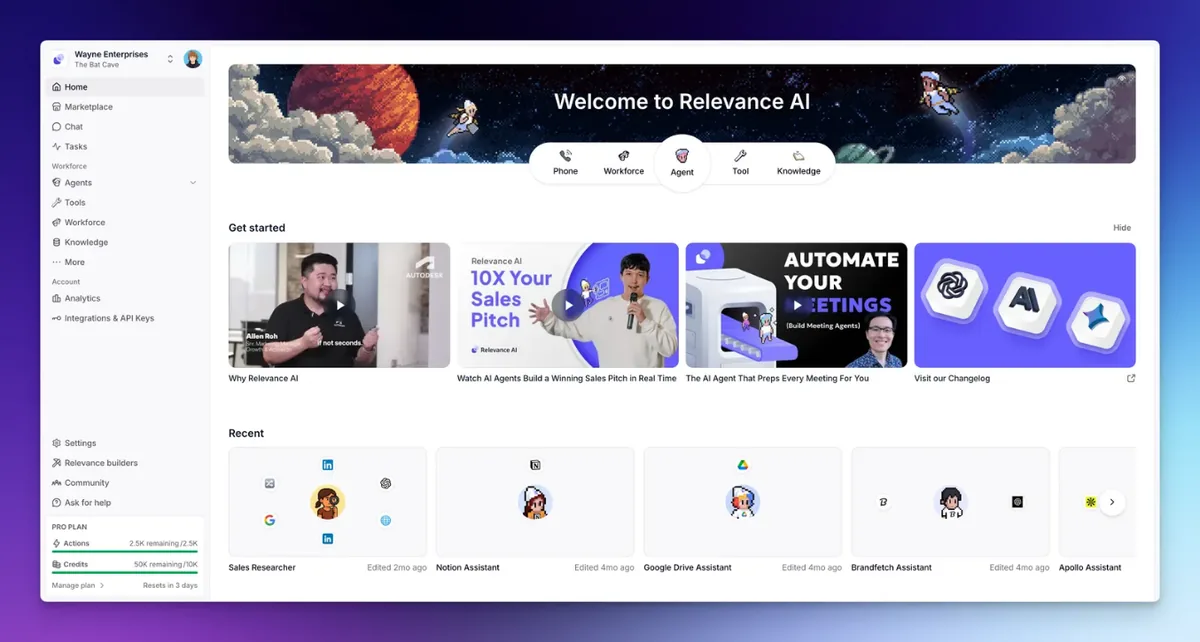
Ledgerline covers the practical work of buying enterprise AI: choosing a platform, comparing what the quote includes and deciding who will keep it running. Last updated:
Relevance AI is a strong alternative if the first deployment should leave your staff able to build the next one. Its proposed handover matters as much as the initial launch: compare what the team will learn and what it must take over.1,5This is our reading of the cited material for a buyer with this need. We have not measured the product’s performance.
Best for
Operations or revenue teams that want to build their own agents over time.
Avoid when
Nobody on your team is ready to take over building and supervision after launch.
Relevance AI: a no code platform for teams of AI agents
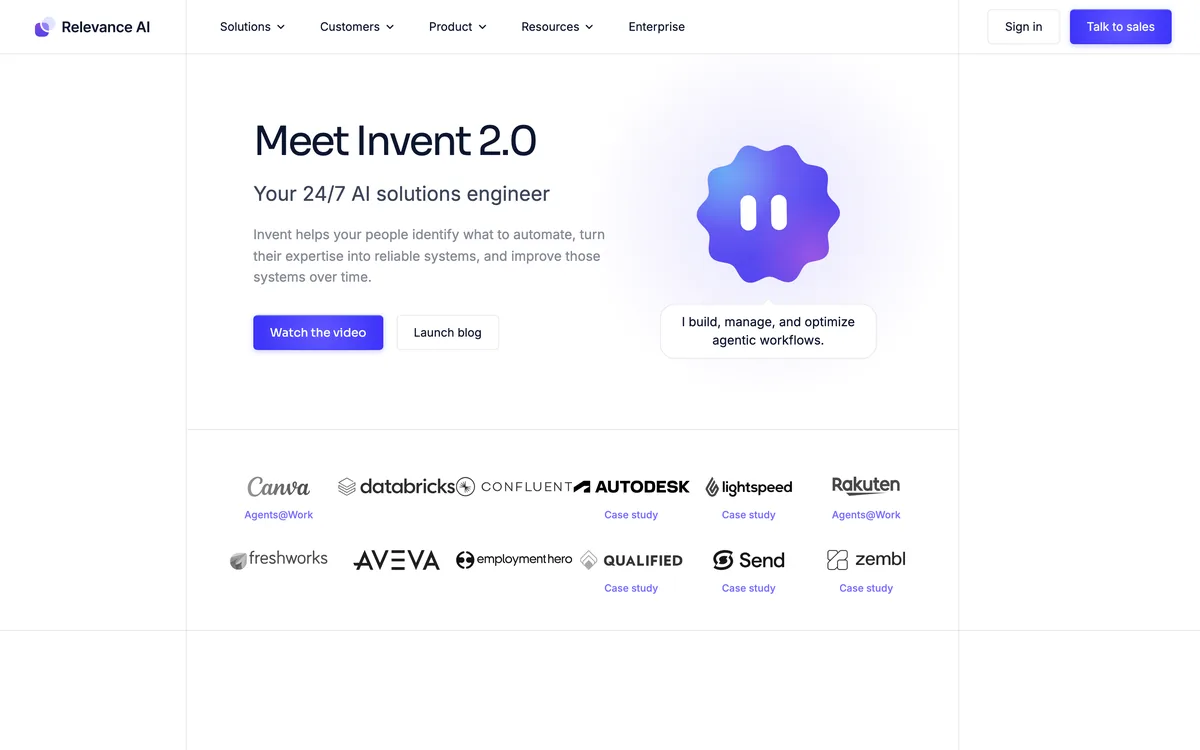
Relevance AI: Relevance AI homepage introducing Invent 2.0 with customer logos below. Source: relevanceai.com, checked November 9, 2026.
Relevance AI describes itself as a low code and no code platform where companies build AI agents and teams of several agents that work together11. Its product page reduces the offer to building, running and managing agents at scale12, and its home page calls the company the home of the AI Workforce13. That vocabulary tells a reader how the product wants to be judged. The pitch is a place where a business assembles digital workers and then supervises them, and the question for a buyer is how much of that supervision the platform really carries.
The public material is unusually detailed on several of the points that matter in a purchase. Prices for two of the three current plans are published, the limits of support are written down, and the documentation states plainly what the company will and will not do when a customer reports a problem. The sections below walk through what those pages say, and they mark the numbers that come from the vendor's own marketing so that a reader can weigh them accordingly.
On traction, the company says it has helped thousands of teams launch an AI workforce14 and it cites a rating of 4.5 stars on G215. Both figures come from its home page and neither should carry much weight on its own. Their use is as a starting point for reference calls, and the customer examples further down this assessment deserve the same treatment.
What the product is
The product brings together the parts a team needs to give an agent a job. An agent is the unit of work, and the agents page describes teams of specialist agents that a company's own staff create in plain language without writing code16. Tools give an agent the means to act, knowledge gives it material to draw on, and a workforce links several agents so that work can pass between them. Guardrails then decide where a person must step in17,18.
The company also presents a layer that sits ahead of the building itself. The home page says that Invent helps a company's people identify what to automate19, and the product page explains the mechanics: a person describes the agent in plain language and Invent generates it, along with its prompt, its tools and its evals20. For a buyer this is a distinctive idea in the offer19,20. Choosing which task to hand over is part of the evaluation, so include Invent's suggestions in the trial rather than assuming the first proposed use case is the right one. The quality of what Invent proposes is something only a trial on real work can show.
Multi agent orchestration is built on graphs of nodes and edges21, which gives more technical users a structure they can reason about. The company says that the people who manage agents day to day are the ops and revenue teams, whom it describes as those closest to the work22. At the same time, engineers can drive the same platform from Claude Code, Codex or Cursor23, and the install command shown for the MCP route is mcp add relevance-ai24. The design therefore tries to serve two audiences on one system. Whether both are well served in a given company depends on who ends up owning the agents after launch, and that is worth deciding before any contract is signed.
How an agent gets built
The documentation sets out the path in five steps25,26,27,17,18. In the first, a team builds its agents with Invent, clones one from the Marketplace or starts from scratch25. In the second, the agents receive tools, all of which are made in a no code tool builder26. In the third, knowledge is uploaded or synced from Google Drive, SharePoint, Notion or websites27. In the fourth, several agents are linked into a workforce on a visual canvas17. In the fifth, the team sets its guardrails through escalations, approval workflows and triggers18.
The sequence is sensible because control comes at the end of a build and is treated as a step of its own. For teams whose tasks exceed what the no code builder handles, tools can run sandboxed Python and JavaScript28, which gives developers a route into the same agent without leaving the platform.
Two quality mechanisms deserve particular attention. Every change re-runs the agent's evaluation suite before it publishes5, so an edit that breaks expected behaviour should be caught ahead of release. After release, the company says it keeps scoring a sample of live production runs in order to catch drift29. Together these describe a testing discipline that covers both the moment of change and the months that follow. The value depends on the evaluations a team writes or accepts, since a suite is only as demanding as its contents, and a buyer should look closely at what Invent generates in that area.
Implementation and the people who help
Relevance AI gives two different accounts of how quickly a customer can begin, and both are useful once they are read in context. The documentation says agents can be deployed in minutes with the no code builder or with pre built templates30. The agents page says that some use cases can take as little as a few hours to stand up31, a statement the company makes about its own product. Minutes and hours are plausible for a first working agent. A production rollout in a large organisation also has to pass through access reviews and testing against live systems, and the speed of those stages depends on the customer as much as on the software.
The more important statement for an enterprise buyer concerns people. The agents page says an embedded deployment team gets the customer live and then trains the customer's team to build quickly on its own32. The same page says the company helps map workflows and find the best agent use cases for the organisation33. This is a meaningful offer, since it moves part of the implementation burden onto the vendor and sets a clear goal for the handover. A buyer should ask which plans include that team, how long it stays, and what the customer is expected to prepare, and should have the answers written into the contract.
Integrations and triggers
The integration story is broad, although the published numbers vary from page to page. The integrations page leads with more than 2,000 integrations, from Slack to Salesforce34, and its directory counts 2,728 in total35. The pricing page also lists more than 2,000 integrations on the Enterprise tier36. The home page says Relevance connects to more than 1,000 apps37, and the product page describes more than 1,000 native connectors, together with MCP support and the ability to build custom connectors38.
These figures can be reconciled in more than one way. One possible reading is that the larger numbers count a wider category of integration than the native connectors, but that remains a guess. The practical advice is the same in either case. A buyer should list the systems an agent must reach, ask whether each connector reads and writes, and test the two or three that matter most. The option of building custom connectors, and the MCP support38, reduce the risk that one missing system blocks a project.
Agents can be started in several ways. A trigger can come from a schedule, from an event in a connected app, from a webhook or from a custom signal39. That range covers both the background work that runs on a timetable and the reactive work that begins when something happens in another system.
Security, certifications and data
Relevance AI's enterprise page lists SOC 2 Type II as a badge40, and its documentation states in plain words that the company is SOC 2 Type II compliant41. The enterprise page also lists GDPR42. Those two items also appear lower down the price list, since the feature list for the Pro plan includes SOC 2 and GDPR compliance43. A buyer should treat a badge as an invitation to request the report itself, and should ask for it under a confidentiality agreement early in the process.
The enterprise page lists encryption at rest44 and a 99.9 percent uptime service level agreement45. It also includes a control described as no training on your data46. The documentation adds that Project Information is confidential, even from Relevance AI47. Since that sentence is strong, a buyer's counsel will want to see how the term Project Information is defined and how it relates to the data that agents process during a run.
Personal data has its own control. A changelog entry says that a customer can mask or block personally identifiable information such as email addresses and phone numbers48. A test on realistic records is a sensible step before relying on it.
Governance and control
Access is handled through role based access control49 and single sign on with SAML50, both listed among the enterprise controls. The product page says one pane covers access control, permissions and data security51. The enterprise page says a customer can set quality standards, define guardrails and monitor every agent52, which is the company's summary of its own capability and is best checked against a working demonstration.
The approval model is more specific than the other controls in this section53,3. High stakes actions pause for human sign off, and the customer sets the thresholds53. The product page lists approval rules that apply to a single tool3 and conditional approval rules4, which suggests that a team can require a person only where the consequence justifies the interruption. Escalations can go out by email and Slack54. Agents exist as draft, active and pinned versions55, so a team can work on a change without disturbing what is running.
Taken together, these controls cover who may change an agent and where a person is asked to approve. A security reviewer can ask who may change an agent, a process owner can ask where a person is required, and a platform team can ask which version is live, and each of those questions has a named feature to examine.
Deployment and audit data
Data residency is listed among the enterprise controls56, and a buyer with a specific region in mind should ask which regions are available and whether every processing step stays inside them. On premises, customer VPC or self hosted deployment of the Relevance platform is not publicly stated on the pages we opened. A company whose policy requires one of those arrangements should raise it in the first conversation.
Audit logs appear in the enterprise controls and the changelog. Audit logs are listed among the enterprise controls57. The changelog says audit logs and execution traces can be streamed to a destination the customer owns7 and that AI audit logs and traces can be streamed in OpenTelemetry format58. The enterprise page also lists export through OTEL and Delta Share59. For a company with an existing monitoring estate this is a concrete benefit, because records of agent behaviour can sit beside the rest of its operational data and fall under its own retention rules.
Pricing and commercial terms
Relevance AI publishes dollar prices for two of its three plans60,61,62. The Pro plan starts at 19 dollars a month60, which is the rate for annual billing, and it costs 29 dollars a month when billed monthly63. The Team plan costs 234 dollars a month billed annually or 349 dollars billed monthly61. The documentation says annual billing saves 33 percent over the monthly rate64. Enterprise is a custom tier with a dedicated account manager62, and the pricing page lists it with no dollar amounts, while the dollar prices for the other plans appear on the documentation pricing page65.
Consumption is measured in two units, and a buyer needs to model both. Pro includes 30,000 Actions a year, or 2,500 a month9, and additional Actions cost 80 dollars per 1,00066. Vendor Credits cover AI model and tool usage, which the company says it passes through at wholesale with no markup10, and additional credits cost 20 dollars per 10,00067. The Pro plan also allows customers to bring their own API keys68. A finance team should estimate how many Actions a typical run uses, because the low entry price says little about the cost of a busy agent.
The audience for each plan is stated. Pro is for solo GTM operators69, and it allows 2 build users and 1 project70. Team is for teams building at scale71, and its list adds calling and meeting agents on top of Pro72. Enterprise is aimed at companies looking to decouple growth from headcount through an AI workforce73. The Free plan has been retired for new signups and for existing accounts74, and the Business plan has been sunset, with Business customers moved to Team75. Anyone reading an older review should check it against the current plan names.
Several smaller terms are worth reading before purchase. Subscriptions cannot be transferred from one Organization to another76, which matters to a group that may later reorganise its accounts. Top ups require an active paid subscription77, and Actions must be bought in increments of 1,00078. Rollover is described for Pro and Team, and Enterprise customers are told to confirm rollover terms with their account manager79.
Support
The support page is candid. Dedicated staff calls are offered to Enterprise customers only80, and no service levels are offered to free customers81. Support runs on weekdays from 9am to 5pm Sydney time, with no weekend support82. A buyer outside that time zone should work out how the window falls against its own working day and agree escalation paths for the agents it considers critical.
Two further statements set expectations. An AI support agent named Harley is in beta and may have bugs or errors83. Bug reports are sent to engineering, and the company says it does not respond to them84. It is unusual to see this written down so directly, and a customer can at least plan around it.
Where Relevance AI fits
The home page lists use cases in Sales, Customer Success, Marketing, Customer Support, Operations, Research and Human Resources85. The commercial emphasis is visible in the language of the plans, with solo GTM operators at the entry level69 and ops and revenue teams named as the day to day managers of agents22. A company whose first candidates sit in those functions will find material written for those functions85.
The customer examples on the home page follow the same pattern and are reported by the vendor86,87,88. Send Payments is said to save 40 hours a week across global operations86. Zembl is said to achieve 30 percent more customer conversions with AI sales coverage around the clock87. Qualified is said to have generated 7 million dollars in pipeline with more than 35 agents across the organisation88. The home page also carries a named testimonial from a senior marketing manager at Autodesk89. A prospective buyer should ask how each result was measured and over what period.
Where it falls short
The limits below come from the company's own pages. Support hours are confined to the Sydney working week82, staff calls are reserved for Enterprise80, and bug reports receive no reply84. For a team whose agents touch customers at all hours, those terms need attention in the contract, and the Enterprise tier is the place to negotiate them. The Pro plan allows 2 build users and 1 project70, so a department that wants to experiment with more than one project will reach the Team price of 234 dollars a month quickly61. Since the Free plan has been retired74, a buyer should ask how an evaluation can begin.
The published integration counts differ between 1,000 and 2,72837,35, and a buyer should not rely on any of them until the specific connectors have been confirmed. The hosting position also needs an early answer, since on premises, customer VPC and self hosted deployment are not publicly stated on the pages we opened. Rollover for Enterprise customers has to be confirmed separately with the account manager79. Finally, the outcomes quoted on the home page86,87,88 are the company's own examples, and a buyer should ask for the method behind them.
Verdict
Relevance AI makes a strong case on three points. It publishes dollar prices for its Pro and Team plans63,61, it offers an embedded deployment team that hands over to the customer32, and it documents a control set that runs from conditional approvals4 to audit traces streamed to a customer owned destination7. Its evaluation gate before each publish5 is a practical safeguard, and its candour about support limits84 helps a buyer plan.
It suits a company with commercial or operational use cases that wants business staff to build agents and whose hosting needs match what the vendor offers. A buyer that needs a hosting model the pages we opened do not state, or support across every time zone, has specific questions to resolve first. Use the evaluation to measure Actions and Vendor Credits for a representative workflow. Confirm which deployment help the plan includes, who takes over afterwards and how an urgent issue reaches a person outside the standard support window.
What buyers should test
We distinguish dated supplier documents, direct company confirmations and our own analysis. Documentation tells us what a supplier says; it does not prove how the product performs. Where the evidence leaves a question unanswered, we explain what your buying team still needs to ask.
Help with the build
Documented
Relevance AI describes an embedded team that gets the customer live, then trains its staff.1This is the supplier’s statement in material checked November 8, 2026. We have not tested it ourselves.
Evidence
Which plan includes that team, when does it hand over and what must your staff be able to do?
Ask who handles discovery, setup, testing, support and changes, and what your team must have ready first.
Your existing systems
Partly documented
The Enterprise plan lists integrations, single sign-on, access based on roles and audit logs.2This is the supplier’s statement in material checked November 8, 2026. We have not tested it ourselves.
Evidence
Does each connection support the action, trigger and sign-in method your process needs?
Ask to see the records and actions you need. Check sign-in, permissions, limits, custom work and who maintains each connection.
Checks you can see
Documented
Relevance AI lists approvals for individual tools and rules for when approval is needed. It also says evaluations rerun before changes are published.3,4,5This is the supplier’s statement in material checked November 8, 2026. We have not tested it ourselves.
Evidence
Who writes the evaluations, who can bypass an approval and what happens if a check fails?
Request evidence for the exact product. Ask to see access refused, approval requested, permission removed and the resulting action traced.
Where your data goes
Partly documented
Its Enterprise page says customer data is not used for training. Its changelog describes sending execution traces to a destination the customer owns.6,7This is the supplier’s statement in material checked November 8, 2026. We have not tested it ourselves.
Evidence
Where are the workspace and exported logs processed, which other companies handle them and how long are they kept?
Request a diagram of the data’s route, with hosting regions, model providers, retention rules and who gets access.
The full cost
Partly documented
Enterprise purchases go through sales. Published usage documentation separates Actions from Vendor Credits for model and tool usage.8,9,10This is the supplier’s statement in material checked November 8, 2026. We have not tested it ourselves.
Evidence
Will your Enterprise quote use those measures, and what do retries, top-ups and support cost?
Ask for an itemized proposal covering setup, software, usage, support, your own staff’s work, changes and what you receive when the service ends.
Sources
Relevance AI states an embedded deployment team that then trains the customer. relevanceai.com, checked November 8, 2026.
Relevance AI Enterprise lists 2,000+ integrations and SSO, RBAC, audit logs. relevanceai.com/pricing, checked November 8, 2026.
Per-tool approval rules are listed as a feature. relevanceai.com/product, checked November 8, 2026.
Conditional approval rules are listed as a feature. relevanceai.com/product, checked November 8, 2026.
Every change re-runs the agent's eval suite before it publishes. relevanceai.com/product, checked November 8, 2026.
Relevance AI lists PII masking, human in the loop approvals, role based access control, no training on your data. relevanceai.com/enterprise, checked November 8, 2026.
Changelog: audit logs and execution traces can be streamed to a customer-owned destination. relevanceai.com/docs/changelog, checked November 8, 2026.
Relevance AI Enterprise is bought through sales. relevanceai.com/pricing, checked November 8, 2026.
Product page describes the platform as one that builds, runs and manages AI agents at scale. relevanceai.com/product, checked November 8, 2026.
Homepage tagline. relevanceai.com, checked November 8, 2026.
Vendor claims it has helped thousands of teams launch an AI workforce (vendor claim). relevanceai.com, checked November 8, 2026.
Vendor cites a 4.5-star rating on G2 (vendor claim). relevanceai.com, checked November 8, 2026.
Agents page pitch: teams of specialist agents, created by your team in plain language, no code required. relevanceai.com/agents, checked November 8, 2026.
Product page says one pane covers access control, permissions and data security. relevanceai.com/product, checked November 8, 2026.
Enterprise page says quality standards, guardrails and monitoring are set for every agent (vendor claim). relevanceai.com/enterprise, checked November 8, 2026.
High-stakes actions pause for human sign-off, and the customer sets the thresholds. relevanceai.com/enterprise, checked November 8, 2026.
Escalations by email and Slack are listed as a feature. relevanceai.com/product, checked November 8, 2026.
Draft, active and pinned agent versions are listed as a feature. relevanceai.com/product, checked November 8, 2026.
Data residency is listed among the enterprise controls. relevanceai.com/enterprise, checked November 8, 2026.
Audit logs are listed among the enterprise controls. relevanceai.com/enterprise, checked November 8, 2026.
Changelog: AI audit logs and traces can be streamed in OpenTelemetry format. relevanceai.com/docs/changelog, checked November 8, 2026.
Enterprise page lists OTEL and Delta Share export. relevanceai.com/enterprise, checked November 8, 2026.
Pricing page lists the Enterprise tier with no dollar amounts; dollar prices appear on the docs pricing page. relevanceai.com/pricing, checked November 8, 2026.
Rollover is described for Pro and Team; Enterprise customers should confirm rollover terms with their account manager. relevanceai.com/docs/get-started/pricing, checked November 8, 2026.
Use cases listed on the homepage include Human Resources, alongside Sales, Customer Success, Marketing, Customer Support, Operations and Research. relevanceai.com, checked November 8, 2026.
Vendor customer example: Send Payments saves 40 hours weekly across global operations. relevanceai.com, checked November 8, 2026.
Vendor customer example: Zembl reports 30% more customer conversions with 24/7 AI sales coverage. relevanceai.com, checked November 8, 2026.
Vendor customer example: a claimed $7M pipeline from 35+ agents across the org. relevanceai.com, checked November 8, 2026.
Named testimonial from a senior marketing manager at Autodesk. relevanceai.com, checked November 8, 2026.